Search This Blog

Showing posts with label TED Talk Analysis. Show all posts

Tuesday, November 17, 2015

TED Talk Analysis

TED Talk Analysis
Jordan McCay

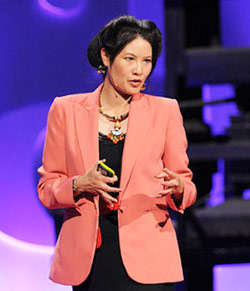
For my analysis of a TED talk, I chose Mia Birdsong's "The Story We Tell About Poverty Isn't True" that was given in May 2015. Mia's talk relates very much to the Step By Step organization in that many of the single mothers and their children are currently experiencing poverty. However, as Mia describes in her talk, this situation does not make them weak. In fact, it only fully displays their strong will and strength of character. They are "broke, but not broken."

Out of all of the TED talks I've watched, I can honestly say that this one struck me as the most genuine in both her feelings for the topic and her quality of conversation. Mia's passion for her topic and her closeness with it was highly evident in her presentation. This was a true showcase of the master within. Her stories, not only about herself, but of people living in the poverty she once was in too, struck deep. It was hard not to become emotional upon hearing of the resilience of these people. As Mia mentioned in her presentation, society has a very nasty habit of trying to demonize poor people. By sharing these stories with the audience, Mia was able to break through some of that and have them be seen as the equivalent human beings they should be. Along with these stories, Mia showed pictures of the people she was discussing, thus providing a multi sensory experience for the audience.
One of Mia's main points in her presentation
Another cool thing about this TED talk was that I learned of a place called Silicon Valley. It's been a starting point for many companies and doesn't judge based on a person's wealth or lack thereof it. I just though it was neat that somewhere like that exists. It gives one hope that in the near future there will be many places like this, where ideas are valued for their merit rather than the monetary value of their creator.

In a way, I think Mia's presentation was low-key jaw-dropping throughout the entire presentation, but especially as she firmly established the value of poor people in society and gently berated the rest of society for treating them so harshly. I suppose it was so jaw-dropping because she talks in such a way that's both light-hearted (so you don't expect such passion and ferocity to come from her) and intense all at once. Mia's light-heartedness also shown through the humor she incorporated into the presentation, which worked as she was joking with a sense of familiarity and created a sense of companionship with the audience, as well as adding to her genuine nature.

In the end, I was surprised that the speech was a little over 15 minutes long (under that 18 minute rule, of course), because it had felt so short in such a good way. I was absolutely enraptured with her and was with her the entire time. Her ability to stay in her lane and connect everything back to her main point was impressive. I think Mia's TED talk was highly effective and served her purpose: getting the populace to consider poor people in a new light and looking to them as useful resources. I feel like I, too, gained a new perspective by watching this, and I encourage anyone reading this post to also take a look into it. It's well worth those 15 minutes.




Tomorrow: TED Talk Analysis

By: Phyllis Elizabeth Holloway


“None of us can change our yesterdays but all of us can change our tomorrow.” 
-Colin Powell 


Powell's official portrait as the Secretary of State
Here's the link!
For my TED Talk Analysis, I chose to analyze Colin Powell’s TED Talk “Kids Need Structure”. The speech was delivered in 2012 at TEDxMidAtlantic. This TED Talk ties in very well to my service-learning organization, Step By Step, because it is a speech about how the world as we know it can change to provide a better future for the upcoming generations. Colin Powell speaks about how we can help children get a good start on life.

General Colin Powell is the former United States Secretary of State, and was the first African American to serve in this position. As you see in the picture below of Powell in uniform, you see that he is a very decorated veteran. There are many different opinions on Powell’s credibility, especially on the subject of education. Since Powell never served as an educator outside of the military, many believe he was not fit to deliver this TED Talk. Some comments brought up things that happened while he was in office. Some had a more open-minded approach to the talk.

General Colin Powell waving in a
New York City Welcome Home Parade
Here's the link!
Like many others, I agree that Powell delivered a powerful message. Powell made a strong point to encourage the community to become a part of young people’s education. As Powell points out, a child begins learning just after the child is born. One of his big points is saying that, “A child who has not been read to is in danger when that child gets to school.” This is something that I whole-heartedly believe in. I was read to as a child and I believe it has made me a stronger student and a better person. Although I agree with his point, I would have liked some research that backed up the statement. 

Powell relied heavily on his past in the military. This is something that anyone who knew Powell would expect. You can see the passion he had for his participation in the ROTC. I appreciate his passion for the topic as it made it a lot more enjoyable and easier for me to tune in to what he was saying. Powell shared stories throughout the speech, which also kept the audience very engaged into the message he was trying to share with them. He kept eye contact and great organization throughout his speech. Powell stayed very true to himself during this speech. 

Colin Powell delivering his TED Talk with the picture he
used to kick off his speech.
Here's the link! 
At the beginning of his speech, Powell shared a photo that he then told a story about. He did not have a powerpoint filled with words, so that made his presentation engaging. I think the audience expected more engaging images, though. Powell once took a stab at his younger self, to make the audience see that he doesn’t take himself too seriously, and to keep them engaged with laughter. Also, near the beginning of the speech he was telling a story, and it seemed like he was losing the audience. Powell yelled “AT EASE!” and I believe he caught the audience’s attention again. 

I think the audience knows that kids need the basic necessities to survive. I believe that the things such as attention, love, and structure are very often overlooked. All in all, I believe that Powell made a strong message (that was under the 18 minute limit!) that has the possibility of changing lives for generations to come. I agree with Colin Powell when he says, “Every child ought to have a good start in life.” 

I encourage you to watch this TED Talk for yourself!

Monday, November 16, 2015

Analyzing a TED Talk


The speech I chose to analyze was by Jennifer Senior titled ‘For parents, happiness is a very high bar.’  Senior gave this talk at TED2014.  I enjoyed listening to this talk, and I learned new facts about parenting I had never heard of before. 
Jennifer Senior presenting her TED Talk
Jennifer Senior did a very good job at getting her point across and relating her speech to the audience.  She told a story about the different books that are being sold on how to raise children and how much parenting has changed since she was a child.  She told another story about holding her first child in her arms and promising to never hurt him, made her speech more personal, and also related to how happiness is very hard to give to someone.  With this story she got her point across that her promise she made is an easier and more attainable goal than trying to make your child happy.  Throughout the whole presentation, Senior made it feel like she was having a conversation with her audience.  She used PowerPoint slides, which had only pictures or had very few words.  This helped to emphasize her points and was not too overwhelming for her audience.

Listening to this presentation, I learned many new facts about modern parenting.  One fact that surprised me was the shocking statistic that the United States was one of eight countries that do not have paid maternity leave; this makes it so much harder on mothers to be able to support their family and give their children the best life they can have.  She also presented the fact that mothers now spend more time with their children then they did decades of years earlier when not many of them had jobs.  So much has changed in the past few years, and so much will change in the years to come.  She pointed out that happiness is not something you are able to give to your children.  You just have to teach them and help them get to a point that makes them happy.  To make her speech livelier Senior put some humor into it.  She started her speech with a joke which pulled people in and helped them to focus on what she was saying.  Also throughout her speech she would put little pieces of humor, which helped her audience focus again and it helped defuse some of the seriousness of the talk.

Jennifer Senior was able to paint a picture through her words about her speech on happiness.  She used her own experiences and she was knowledgeable about her subject.  She used stories and images that her audience was able to relate to, and therefore they are about to visualize the story in their mind.  She did all of this is in 18 minutes, and having this time limit gave her enough time to cover her topic well and did not give her time to deviate from her track.  

These are some of the words that describe parenting
‘For parents, happiness is a very high bar’ by Jennifer Senior was a great TED talk.  It related to my service organization Step By Step, which helps single mothers and their children.  This talk made me realize how stressful it can be to be a parent, and how much harder it would have to be if you were young and on your own.  Parents want their child to be happy, but that is an unrealistic goal for the parents to give themselves.  There is no guidebook for the parents to follow they just have to do the best they can and hope that the child’s happiness will follow.

Analyzing a Ted Talk: Our Century's Greatest Injustice

                Sheryl WuDunn wrote a book, Half the Sky, about women around the world, and the oppression they face. Her Ted Talk given on July 10, 2010, “Our Century’s Greatest Injustice” was given to a smart audience, an audience of potential investors who likely had good intentions but were not necessarily informed on the issue.  Her goal was to persuade them to reach out and help women who live in desperate poverty. Speaking to an audience like the one she addressed must be done with the greatest care. If she spoke too bluntly about the need for change and the patheticness of current help, she could offend the sensitive intellects of a crowd that likely considered itself humane; however, if she watered down her message she risked boring her audience into inaction. Instead, she carefully walked a tightrope, drawing her audience along with her using humor and stories, yet never shocking or scolding enough to push them off the edge.

Sheryl WuDunn gestures in the power sphere during her speech
Sheryl WuDunn’s Ted Talk was about women in poverty, just like many of the women Step-by-Step seeks to aid.  She began by showing a picture of herself in China, looking happy and safe. Then she showed a very different picture: the picture of a thirteen year old girl who could not afford to go to school and who lived in squalor because of this. Yet the story did not end in dismay, but in hope. Generous donations allowed the school to provide scholarships, and she not only finished school but brought prosperity to her family and village. This developed Mrs. WuDunn’s main point: women, when empowered, “move out of a vicious cycle and into a virtuous one”.


She gave more examples. She asked her audience whether they believed more men or women were alive on earth. The audience, being fairly well-educated, guessed that more women were alive, perhaps because women tend to live longer. Sheryl shocked them by explaining that far more men than women are actually alive, then went on to explain why: girls are often fed less or given less care, “discriminated to death”. Then she described some of the worst challenges facing girls. Many of them are sold into sex trafficking – others die in childbirth. Sheryl wove stories of individual women and girls into her talk, showing pictures and explaining how they had risen from vicious cycles to virtuous ones. She concluded by highlighting a few of the practical benefits of aiding women, and by inspiring others to act by saying that we “provide for wild birds so they don’t go hungry”. If we can provide such care for the birds, can we not care for each other?  
If we care for the birds, can we not care for women?


The speech was incredibly effective. When I finished watching it I wanted to rush out and give all my money to help impoverished women! By incorporating mild humor, interesting pictures, and vivid stories, Sheryl captured my attention for a full 18 minutes. She made eye contact frequently with the audience and used gestures to emphasize her points. To make the speech even more effective, she could have made it a bit more memorable. Although the speech was well-organized, there were too many chunks of information for me to remember all of the “main points”. By simplifying the speech even more into even broader areas, then elaborating on those, Mrs. WuDunn could have imprinted her ideas into my mind more firmly. Her speech tied beautifully in to the main goal of Step-by-Step: to empower women by breaking bad cycles and connecting them to the resources that create good cycles instead. Just as women in third-world countries can do incredible things if given the opportunity, women in America, given the right resources, can work miniature miracles. 

Thursday, November 12, 2015

Analyzing a TED Talk

In February 2009, at the TED Talk Conference in Long Beach, CA, Jacqueline Novogratz delivered a talk titled “An Escape From Poverty,” in order to relate a personal story about an approach to solving poverty. Novogratz is the founder of a business called Acumen, which seeks a bottom-up approach to poverty through investing in specific early-stage organizations that bring essential services to the world’s poor. Her audience likely knew her background and expected a talk on the issue of poverty, but her personal stories presented it in a new and unprecedented light.

    Novogratz addresses the topic of poverty, an area she clearly feels strong passion for. She relates her personal experience with people in poverty through a single story, about a young woman named Jane who lives in Nairobi, Kenya. Novogratz begins the story with by setting up the physical context, the Methari Valley slums, and describing the population with phrases such as “over half a million people live crammed in these little tin shacks.” Moving into her stride, she relates Jane’s dreams, and how, through an individual loan, she began her own business and work her way up from the bottom. This story of Jane serves as the centerpoint of Novogratz’s talk, and is indeed its strongest element. She makes direct eye contact with the audience, and keeps a gentle yet undeniably intentional mood. Her movements remain within the “power sphere,” adding to the directness of her presentation.
Novogratz uses direct movements to enhance her story.

Novogratz incorporates several elements of novelty within the story. She starts her speech by describing poverty not as a specific income level, but “a condition about choice.” At the end of the story, she reveals that Jane still lives in the slums, despite the success of her business. It is a subtle “jaw-dropping moment,” as an ending that defies a typical “Cinderella” story and reinforces Novogratz’s definition of poverty. There is very little humor in the speech, only a light story told about Novogratz telling the African children that “Obama is my brother too.” Yet Novogratz consistently maintains a gentle tone that keeps the presentation relatively light.
Unfortunately the greatest weakness of Novogratz’s speech is the brevity of it. She speaks for almost eight minutes, much shorter than the recommended eighteen. Though this is likely due to her speech revolving around a personal story, it does make her content seem a bit lacking. The speech is impactful, however, through skillful use of media elements, such as photos of specific areas in the story. Despite the shortness of her talk, she uses photos, as well as a powerful story, to make it memorable. Improvement on this talk should focus on lengthening it, and expanding the content. Ideas within Novogratz’s story could be connected to worldwide events, instead of remaining limited in the Methari Valley slums. Expanding the content and relating it to poverty on a broader scale would most improve this talk.
Novogratz's image of the Methari Valley slums

           This TED talk has a strong link to my service organization, Step by Step, through single motherhood and poverty. The woman in Novogratz’s story was both the daughter of a single mother and a single mother herself, revealing how poverty had specifically impacted her through this. Despite its shortness, Novogratz’s speech revealed a specific story about an impoverished individual, which is an effective tool for raising awareness and empathy. Through my service I have learned the value of seeing not just the broad issue of poverty, but the names and stories of individuals bound by it, and Novogratz’s talk enhanced the value of this for me.